
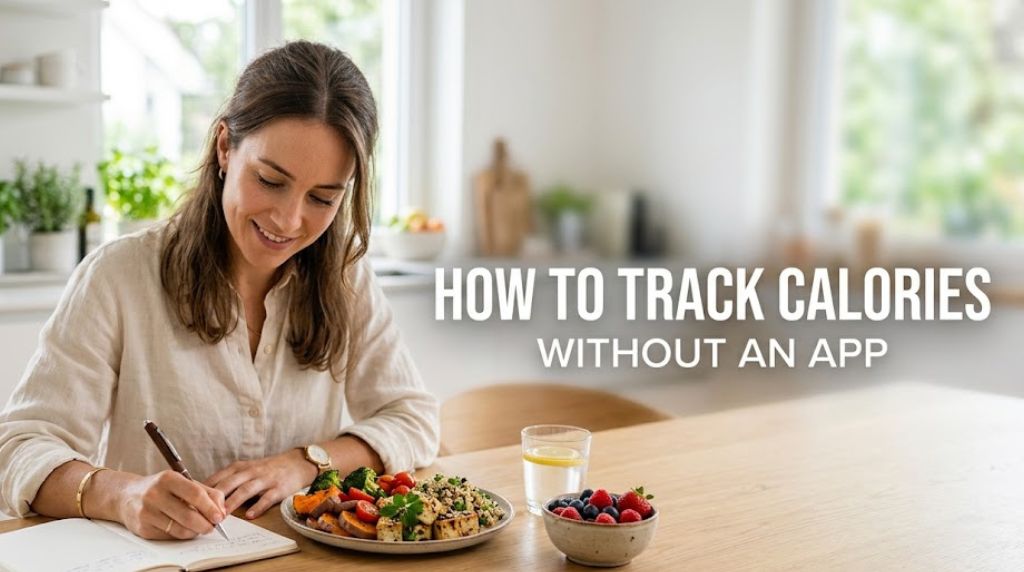
How to Track Calories Without an App: Let’s be real— not everyone wants to pull out their phone every single time they eat a sandwich. And honestly? You don’t have to. Tracking calories without an app is totally doable, and a lot of people actually find it easier and more mindful than tapping away at a screen.
If you’re wondering how to track calories without an app, you’re in the right place. Believe it or not, people were getting fit and staying lean long before smartphones existed. You don’t need a fancy interface to reach your goals—you just need a little bit of “old school” logic and a few simple tools.
Let’s dive into how you can take back control of your plate without opening a single app.
Why Ditch the Apps?
Apps can make us feel obsessive. They turn eating into a math equation rather than an experience. By learning to track manually, you build a much stronger mind-body connection. You start to actually learn what 100 calories of almonds looks like, rather than just mindlessly typing it into a search bar. It builds a skill that lasts a lifetime, not just until your next software update.
1. The Classic Pen and Paper Food Journal


This is the OG of calorie tracking. Grab a notebook — any notebook — and start writing down what you eat throughout the day.
How to do it:
Write down the food, the rough portion size, and the estimated calories. You can look up calories from a simple printed calorie chart (many are available in books or you can jot one down yourself from a one-time search).
Sample Daily Log:
| Meal | Food | Portion | Calories (approx.) |
|---|---|---|---|
| Breakfast | Oats with banana | 1 cup + 1 medium banana | 280 |
| Snack | Handful of almonds | 20g | 120 |
| Lunch | Rice + dal + sabzi | 1 plate | 450 |
| Evening | Chai + 2 biscuits | 1 cup + 2 | 130 |
| Dinner | Roti + paneer curry | 2 roti + 1 bowl | 520 |
| Total | ~1500 kcal |
It doesn’t have to be perfect. Even a rough idea of what you’re eating is way better than nothing.
-
Pro Tip: Don’t worry about being 100% perfect. Aim for “close enough.” If you ate a bowl of dal and rice, estimate the cups and move on.


2. Master “The Hand Rule” for Portion Control
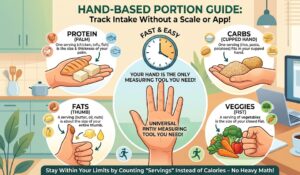

This is a game-changer for busy people. Your hand is the only measuring tool you carry with you everywhere! It’s perfectly scaled to your body size, making it a surprisingly accurate way to track your intake without a scale or an app.
-
Protein (Palm): One serving of protein (chicken, tofu, fish) should be the size and thickness of your palm.
-
Carbs (Cupped Hand): One serving of carbs (rice, pasta, potatoes) should fit in your cupped hand.
-
Fats (Thumb): A serving of fats (butter, oil, nuts) is about the size of your entire thumb.
-
Veggies (Fist): A serving of vegetables should be the size of your closed fist.
By counting “servings” instead of individual calories, you can easily stay within your limits without doing heavy math.
3. Read the Labels (The 100-Calorie Logic)


Most packaged foods have a nutrition label. Instead of logging it into an app, look for the “Per 100g” or “Per Serving” section.
A great trick is to look for foods that come in pre-portioned packs. If a pack of biscuits says 150 calories, you just write “150” in your notebook. If you’re cooking at home, keep a small “cheat sheet” on your fridge with the calorie counts of your 10 most common ingredients (like oats, rice, milk, and eggs).
4. Use Standard Kitchen Tools
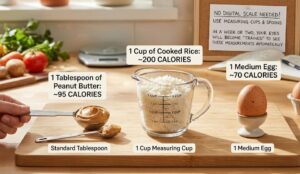

You don’t need a digital scale to be accurate. Use standard measuring cups and spoons.
-
1 Tablespoon of Peanut Butter: ~95 calories.
-
1 Cup of Cooked Rice: ~200 calories.
-
1 Medium Egg: ~70 calories.
Once you use these tools for a week or two, your eyes will become “trained” to see these measurements automatically.
Calorie Estimation Table for Common Foods
Here is a quick reference guide you can screenshot or print out to help with your manual tracking:
| Food Item | Typical Portion Size | Approximate Calories |
| Cooked White Rice | 1 Cupped Hand (1/2 cup) | 100 – 110 |
| Whole Wheat Chapati | 1 Medium | 70 – 80 |
| Dal / Lentil Soup | 1 Small Bowl | 120 – 150 |
| Chicken Breast | 1 Palm Size | 160 – 180 |
| Paneer / Tofu | 1/2 Cup Cubes | 180 – 200 |
| Almonds / Nuts | 1 Small Handful (10-12) | 70 – 90 |
| Cooking Oil / Ghee | 1 Tablespoon | 120 |
| Apple / Banana | 1 Medium Piece | 80 – 100 |
5. The “Plate Method” for Social Dining
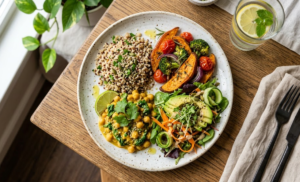

What happens when you go to a party? You can’t pull out a weighing scale! This is where the Plate Method shines.
Divide your plate visually:
-
Half the plate: Fill with non-starchy vegetables (salad, sautéed veggies).
-
One-quarter: Fill with lean protein.
-
One-quarter: Fill with complex carbohydrates.
If you stick to this visual rule, you’ll almost always land between 400 and 600 calories per meal, which is the “sweet spot” for most people looking to lose or maintain weight.
6. Listen to Your Hunger Cues
This is the most “natural” way to track. Apps tell you when to stop eating based on numbers; your body tells you based on hormones.
-
Eat until you are 80% full. This is a Japanese practice called Hara Hachi Bu.
-
It takes about 20 minutes for your brain to realize your stomach is full. If you eat slowly and without distractions (put the phone away!), you’ll naturally eat fewer calories without needing to count them.
7. The Traffic Light System
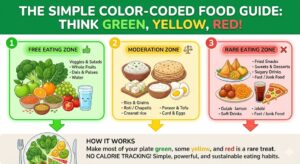

This one’s super simple and perfect if you don’t want to think about numbers at all.
Color-code your foods:
- Green foods — eat freely (veggies, salads, fruits, dal, water)
- Yellow foods — eat in moderation (rice, roti, paneer, curd, eggs)
- Red foods — eat rarely (fried snacks, sweets, sugary drinks, junk food)
You don’t track calories at all here. You just make sure most of your plate is green, some is yellow, and red is a once-in-a-while thing. It’s not the most precise method, but it creates great eating habits over time.
8. Plan Your Meals in Advance
The easiest way to track calories without an app is to already know what you’re going to eat. If you meal prep 3 days of lunches, and you know each lunch is roughly 500 calories, you don’t need to track it every day. You just “know.”
Consistency is the enemy of the calorie-counting app. If your breakfast and lunch are mostly the same every day, you only have to worry about the numbers for dinner.
Summary of Benefits
-
Reduced Stress: No more “red bars” or “over-limit” notifications.
-
Better Privacy: No sharing your data with big tech.
-
Sustainability: You can do this anywhere—at a wedding, on a hike, or at a restaurant.
-
Education: You actually learn about food instead of just following an algorithm.
Tips to Make Manual Tracking Actually Work
Here are a few things that will make this whole process easier:
Keep it simple. Don’t try to track every single ingredient in a dish. Estimate the whole meal.
Be consistent. Even tracking 5 out of 7 days gives you useful information.
Don’t stress about being exact. A 50–100 calorie error here and there is totally fine. The goal is awareness, not perfection.
Keep your journal visible. Leave it on the kitchen counter or dining table so you actually remember to use it.
Review it weekly. Look back at the week and see where most of your calories are coming from. That’s where small changes can make a big difference.
Frequently Asked Questions (FAQs)
1. Is manual tracking as accurate as using an app?
Not perfectly, but it doesn’t need to be! Even apps have a 10-20% margin of error because soil quality and cooking methods change calorie counts. Consistency matters more than 100% precision.
2. How do I track calories in home-cooked meals with many ingredients?
Focus on the “Big Three”: the oil/fat, the protein, and the main carb. The spices, onions, and garlic have negligible calories. If you know you used 2 tablespoons of oil for the whole family, and you ate 1/4th of the dish, just track 0.5 tablespoons of oil.
3. What if I forget to write something down?
Don’t sweat it. Just estimate it later or let it go. One forgotten snack won’t ruin your week. The goal is to build a long-term habit, not a perfect streak.
4. Can I lose weight just by using the “Hand Rule”?
Absolutely. Many professional nutritionists use the hand rule because it prevents “over-measuring” and keeps people from getting burnt out. It’s a very effective way to maintain a calorie deficit.
5. Do I need to buy a food scale?
You don’t need one, but it helps for the first week just to see what a “serving” actually looks like. Once you know, you can put the scale in the cupboard and rely on your eyes and hands.
6. How do I track calories when eating out?
Look for “Comparison Foods.” If you order a burger, look up the general calories for a “cheeseburger” once, remember it’s around 500-700 calories, and jot that down. Don’t stress the details.
Final Thoughts
Learning how to track calories without an app is like learning to drive a manual car. It takes a bit more focus at first, but eventually, it becomes second nature. You’ll find yourself looking at a plate and instinctively knowing if it fits your goals.
Ditch the digital leash, grab a notebook, and start trusting your own intuition. Your fitness journey should feel like freedom, not a chore!

Drop your weight, height, and goal in the comments, and I’ll help you calculate your ideal calorie intake.
If this helped you, share it with someone trying to lose fat 