Should You Take Creatine?
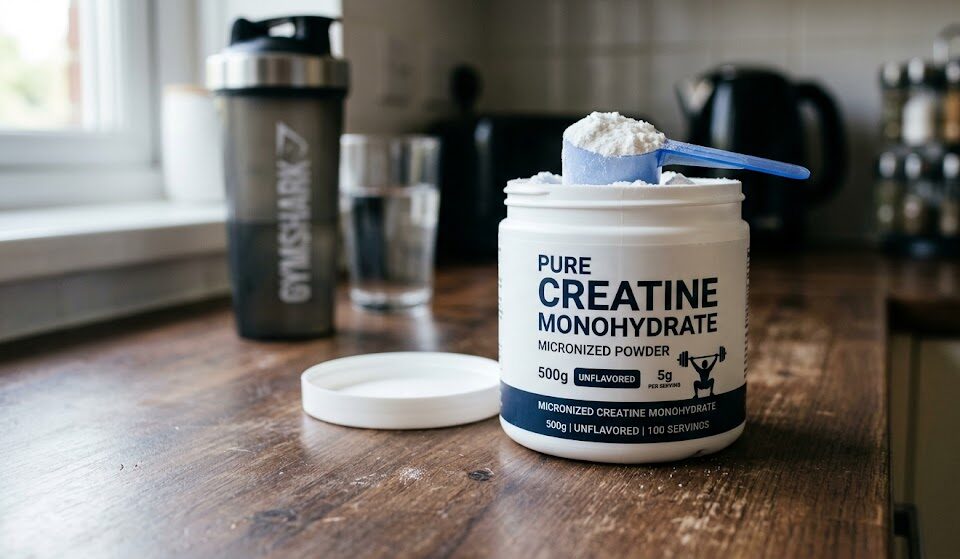
Walk into any gym locker room and you’ll hear it mentioned.. creatine. It sits in white tubs on shelves, gets scooped into shakers, and dominates supplement aisles worldwide. But behind this humble white powder lies a molecule with genuinely fascinating chemistry, a deep evolutionary purpose, and a growing body of research that extends well beyond lifting heavier weights.
Creatine is not a steroid. It is not a synthetic drug. It is a naturally occurring organic compound your own body manufactures every single day, one that has been studied for over 70 years, validated by hundreds of clinical trials, and endorsed by institutions as rigorous as the International Olympic Committee (IOC) and the National Collegiate Athletic Association (NCAA). Understanding creatine means understanding one of the most fundamental systems in human bioenergetics. So let’s start at the beginning- the molecule itself.
The Chemistry: What Exactly Is Creatine?
Creatine is a nitrogenous organic acid. Its chemical name is N-methyl guanidino-acetic acid, and its molecular formula is C₄H₉N₃O₂. Structurally, it is an amino acid derivative, built from three other amino acids- glycine, arginine, and methionine; through a two-step biochemical process that happens primarily in the liver, kidneys, and pancreas.
The body synthesizes roughly 1–2 grams of creatine per day internally. An additional 1–2 grams can be absorbed from dietary sources, predominantly red meat and fish. Beef, herring, salmon, tuna, and pork are among the richest natural sources. However, to obtain even 10 grams of creatine purely from food, you would need to consume roughly 2.5 kilograms of meat, which is precisely why supplementation has become so practical.
Once synthesized or consumed, creatine is transported through the bloodstream and taken up primarily by skeletal muscle. Approximately 95% of the body’s total creatine stores are located in skeletal muscle and the brain. In resting muscle, about two-thirds of creatine exists in the phosphorylated form- phosphocreatine (PCr), also called creatine phosphate, while the remaining one-third is free creatine.
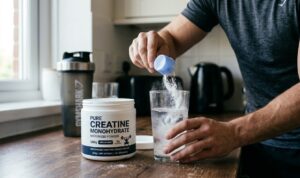
The supplement most people consume, creatine monohydrate is simply a creatine molecule bound to a water molecule, making it more stable and easy to produce as a white, tasteless, odourless powder. It dissolves in water, though somewhat slowly, and is the most researched form of creatine in existence.
The Central Mechanism: Creatine and the ATP–ADP Engine
To understand what creatine does in the body, you first need to understand ATP(adenosine triphosphate), the molecule that powers virtually every biological process in your cells.
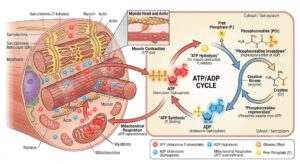
ATP is often called the “energy currency” of the cell. Its structure consists of an adenosine molecule attached to three phosphate groups. The key to its energy lies in the high-energy bonds between these phosphate groups. When a cell needs energy, whether to contract a muscle fibre, fire a neuron, or repair DNA; it cleaves the third phosphate group from ATP through hydrolysis, releasing a significant burst of energy. What remains after this reaction is ADP: adenosine diphosphate, a molecule with only two phosphate groups.
Think of ATP as a fully charged battery and ADP as a discharged one. To reuse it, the cell must “recharge” the battery by re-attaching a phosphate group to ADP, converting it back into ATP. Here’s the challenge: the body cannot store large quantities of ATP because it is a heavy, bulky molecule. And during intense physical activity, the demand for ATP in working muscles can surge by more than 1,000 times compared to resting levels. The body must regenerate it at extraordinary speed.
This is precisely where creatine earns its place. In resting muscle, the enzyme creatine kinase (CK) takes a phosphate group from ATP and attaches it to free creatine, creating phosphocreatine and ADP:
ATP + Creatine → Phosphocreatine (PCr) + ADP
This reaction essentially “charges up” the creatine molecule, storing a high-energy phosphate group for later use.
Then, during intense exercise, when ATP is rapidly being consumed and ADP is accumulating, the reaction reverses. Creatine kinase transfers the phosphate group from phosphocreatine back to ADP, regenerating ATP almost instantaneously:
PCr + ADP → ATP + Creatine (catalysed by creatine kinase)
This reaction is anaerobic. It requires no oxygen and it is nearly instantaneous. It serves as the body’s fastest ATP regeneration system, bridging the energy gap during the critical first 10 to 15 seconds of explosive, high-intensity effort: a maximal sprint, a heavy deadlift, an explosive jump.
Due to creatine kinase’s very high affinity for ADP, this process continues until the phosphocreatine stores fall to near-depleted levels. Only then does the body shift to slower energy systems- glycolysis (breaking down glucose) and oxidative phosphorylation (using oxygen to produce ATP from fat and carbohydrates). These systems work, but they replenish ATP noticeably more slowly than the creatine-phosphate system.
In summary: PCr is a rapid-response energy reserve. Supplementing with creatine increases the size of that reserve.
What Happens in the Body When You Supplement

When you take creatine as a supplement, oral creatine is absorbed through the small intestine, enters the bloodstream, and is taken up by muscle cells via specific creatine transporters. Inside the cell, it interacts with ATP in the mitochondria through creatine kinase to form phosphocreatine, replenishing and expanding those energy reserves.
Research shows that supplemental creatine increases phosphocreatine stores in muscle by approximately 10–40%. Pioneering work by Dr. Roger Harris in the 1990s demonstrated that oral creatine supplementation could increase total creatine content in muscle by up to 20% after just one week of loading.
More stored phosphocreatine means:
- More rapid ATP regeneration — sustaining peak power for longer during each burst of effort
- Faster recovery between sets — PCr stores rebuild during rest, and higher baseline stores mean faster replenishment
- Greater training volume over time — which translates into superior muscle growth and strength gains
- Reduced fatigue — by maintaining ATP availability longer before the body must rely on slower, by-product-producing systems
The creatine kinase system also acts as a cellular buffer. It maintains the ratio between ATP and ADP at a relatively constant level during intense energy consumption; a form of biochemical homeostasis that protects cells from the dysfunction that comes with ATP depletion.
Is Creatine Necessary for People Who Work Out?
This is a nuanced question and the honest answer is: not strictly necessary, but highly beneficial.
Your body produces creatine on its own. You also obtain some from food. But natural creatine stores are rarely saturateD. Most people, especially those eating less than 2,000 calories a day or following vegetarian and vegan diets, operate with sub-optimal creatine levels.
For workout-focused individuals, creatine supplementation is arguably the most effective and evidence-supported legal performance supplement available. Meta-analyses confirm that creatine supplementation leads to approximately 1.14 kg of additional lean muscle gain compared to resistance training alone, alongside modest reductions in body fat. These are significant outcomes from a supplement with an exceptional safety profile.
Creatine is particularly valuable for:
High-intensity and strength training: Lifting, sprinting, HIIT, CrossFit, rowing, any activity that relies on rapid, repeated bursts of maximal effort benefits directly from a larger PCr pool. More phosphocreatine means you can hit harder, recover faster between sets, and accumulate more training volume in each session.
Muscle hypertrophy: The increased training capacity creatine provides, combined with enhanced intracellular water retention in muscle cells (which signals anabolic processes), contributes to greater muscle growth over time.
Endurance athletes: While the benefits are more pronounced in power sports, endurance athletes benefit too- particularly during interval training and high-intensity race efforts.
Vegetarians and vegans: Since plant foods contain negligible creatine, those following plant-based diets typically have significantly lower muscle and blood creatine levels. Supplementation has an even larger relative impact for this group.
For casual gym-goers with moderate goals, creatine still provides meaningful support but the absolute impact is most dramatic for competitive athletes and those doing serious resistance training.
One important note: creatine is not a stimulant. It won’t give you an energy rush. Its benefits compound over time and accumulate across training sessions, which is why consistent, daily use matters more than timing around individual workouts.
Dosing: How Much Should Men and Women Take?
The Two-Phase Protocol
Scientific literature distinguishes between two supplementation approaches:
Loading phase: 20 grams per day (divided into four 5g doses) for 4–7 days. This rapidly saturates muscle creatine stores. It is effective but may cause temporary bloating or mild gastrointestinal discomfort in some people.
Maintenance phase: 3–5 grams per day, taken indefinitely. This is the most commonly used and researched long-term protocol, and it achieves full muscle saturation over roughly 28 days without the loading side effects.
Alternatively, a slow saturation approach, 3 grams per day for 30 days reaches the same endpoint without loading at all. Research confirms that oral creatine supplementation at 4–5 grams per day for up to 18 months has been validated as safe.
For Men
Most men, given their greater muscle mass, benefit from the full 5 grams per day during maintenance. Athletes in heavy training phases or those with above-average body mass may see better results at the higher end (5g) consistently. The standard loading protocol of 20g/day for 5–7 days followed by 3–5g/day for maintenance is the most widely followed and evidence-backed approach for male athletes.
For Women
Women have generally lower baseline intramuscular creatine levels than men, which paradoxically means they may have more room to benefit from supplementation. Research consistently uses the same 3–5 grams per day dosing for women, and a 5-gram serving is considered appropriate for most.
A 2024 study published in Food Science & Nutrition using NHANES data (2017–2020) found that women who consumed at least 13 mg of creatine per kilogram of body mass daily had a significantly lower risk of reproductive disorders, including irregular periods. Women with suboptimal creatine intake also faced elevated risks for several gynaecological conditions, suggesting creatine’s importance extends beyond athletic performance in females.
Research also highlights that women may experience creatine’s benefits differently across the menstrual cycle. During the early follicular and luteal phases, when hormonal fluctuations can amplify fatigue, creatine supplementation may specifically help alleviate fatigue-related symptoms. For postmenopausal women, creatine combined with resistance training shows positive effects on lean mass, bone density, and muscle strength; areas of critical concern in ageing female populations.
Women often consume less dietary creatine than men due to smaller overall portion sizes and lower caloric intake, making supplementation particularly relevant for them. The message from current research is clear: creatine is not a “male supplement.” It is a human supplement.
Beyond the Gym: Creatine’s Wider Benefits
The emerging science of creatine extends well beyond muscle performance:
Brain and cognitive function: Since approximately 5% of the body’s creatine is stored in the brain, and the brain is an energy-intensive organ that relies heavily on ATP, creatine plays a meaningful role in neurological function. Research published in peer-reviewed neuroscience journals suggests creatine supplementation may improve memory, processing speed, and executive function, particularly when the brain is under stress from sleep deprivation, mental fatigue, or hypoxia. These effects appear stronger at higher doses (≥10g/day). Some preliminary studies also suggest creatine may support recovery from mild traumatic brain injury and reduce symptoms of depression, though this remains an active area of research.
Bone health: Creatine may increase the activity of osteoblasts- cells responsible for bone formation, and reduce bone resorption. Combined with resistance training, creatine supplementation has shown positive effects on bone mineral density in clinical and ageing populations.
Ageing and longevity: Natural creatine stores in muscle and brain decline with age. Supplementation in older adults supports maintenance of lean muscle mass and strength both of which are key predictors of longevity and independence.
Neuroprotective potential: Research suggests creatine’s role in maintaining cellular energy buffering may protect against neurological conditions including Parkinson’s disease, Alzheimer’s disease, and Huntington’s disease, though clinical applications in these areas are still under investigation.
Safety, Side Effects, and Common Myths
Creatine has been studied for over seven decades, and no serious adverse side effects have been identified in healthy individuals at standard doses. It is not a hormone, not a steroid, and does not directly alter testosterone levels.
The most commonly reported “side effect” is temporary water retention, muscle cells drawing in more water due to increased creatine storage. This can cause a transient increase in scale weight of 1–2 kg at the start of supplementation, which some people misinterpret as fat gain. It is neither fat nor harmful fluid retention; it is intramuscular hydration, and it actually supports muscle cell function.
There is a persistent myth that creatine harms the kidneys. In healthy individuals with no pre-existing kidney conditions, this has been repeatedly disproven. The confusion arises because creatine supplementation raises creatinine levels in urine and blood, creatinine being the metabolic waste product of creatine breakdown- and elevated creatinine is one marker of kidney disease. However, in healthy individuals, this elevation is benign and simply reflects higher creatine turnover, not kidney dysfunction.
For individuals with existing kidney disease, consultation with a physician before supplementing is recommended.
Choosing a Creatine Supplement
Among the many forms available- creatine hydrochloride, creatine ethyl ester, buffered creatine, creatine gluconate, the evidence overwhelmingly supports creatine monohydrate as the most effective, most affordable, and best-studied form. Other forms may offer marketing claims around solubility or absorption, but no form has consistently outperformed plain creatine monohydrate in clinical trials.
Look for a product with a third-party certification (such as Informed Sport or NSF), no proprietary blends, and a clear label indicating creatine monohydrate as the sole active ingredient. Creapure® is a widely respected, purity-certified branded creatine monohydrate manufactured in Germany.
Conclusion:
Creatine is remarkable not because it is exotic or artificial, but because it is so fundamentally biological. It is woven into the chemistry of energy, the same energy that fires your muscles when you lift, fuels your brain when you think, and keeps your cells alive moment to moment. Supplementing with creatine is, in essence, extending the capacity of one of your body’s most critical energy-recycling systems.
For people who train seriously- men and women alike, creatine monohydrate at 3–5 grams per day is likely the single most evidence-backed supplement available. But even beyond athletic performance, the science increasingly shows that creatine supports brain health, bone density, hormonal wellbeing in women, and healthy ageing in older adults.
It is a white powder, yes. But it is a white powder backed by decades of biochemistry, thousands of clinical studies, and one of the most elegant molecular mechanisms in human physiology. Understanding the science doesn’t just make you a more informed consumer, it helps you respect what this molecule actually does inside you.
Note: Always consult a healthcare professional before beginning any new supplement regimen, particularly if you have pre-existing health conditions. The information in this article is based on current scientific literature and is for educational purposes.
 For more simple fitness tips, beginner-friendly workout plans, and easy habits that actually fit into a busy life, explore more blogs on AasthaFitVerse like Home Workout Plans, Fat Loss Diet Guides, and Daily Fitness Habits—everything is designed to help you stay consistent without stress