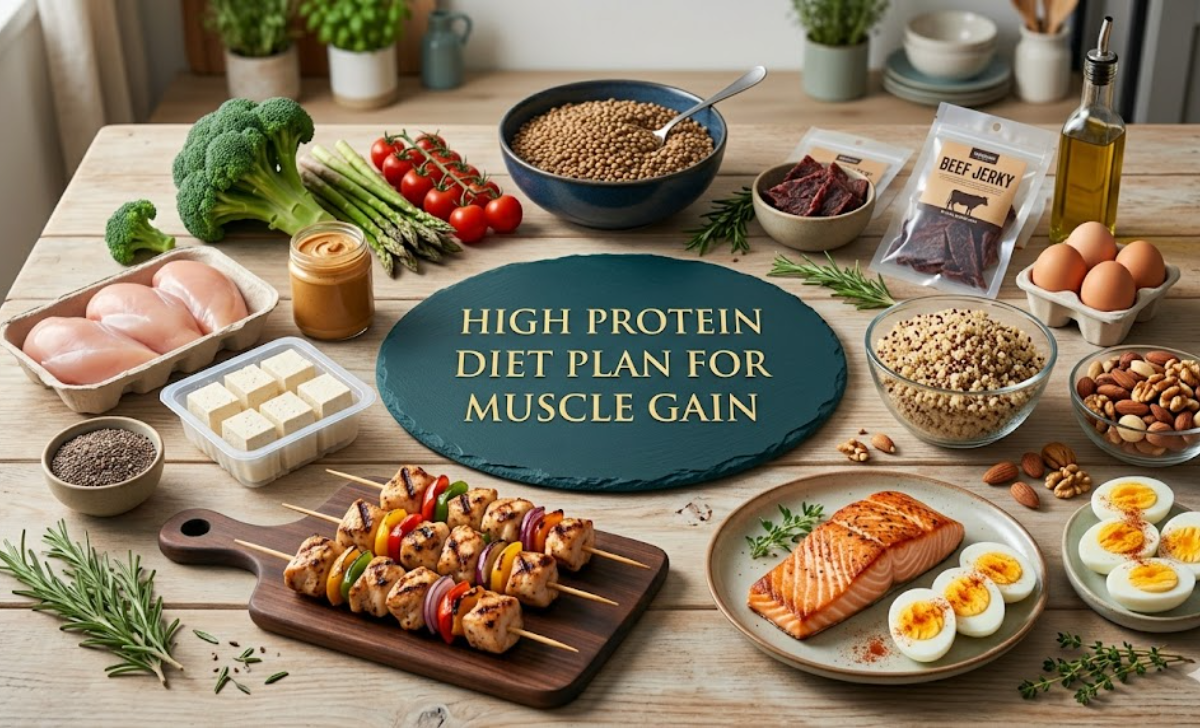
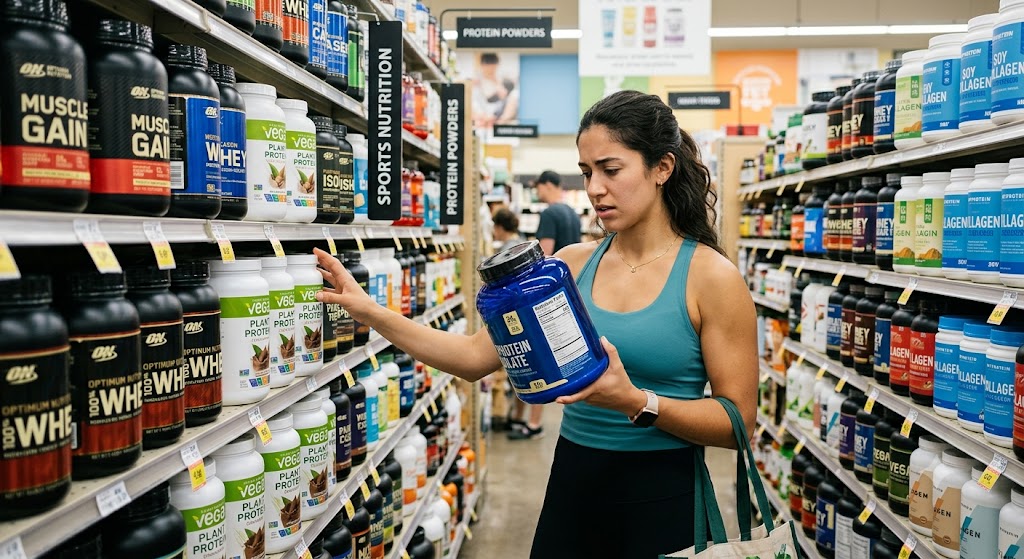
How to Increase Protein Synthesis in the Body: If you have been training hard and still feel like your muscles are not growing the way they should, the answer usually is not more hours in the gym. It is protein synthesis. This is the biological process that actually builds the muscle you are chasing, and most people are working against it without realizing it.
In this guide we are going to break down exactly what protein synthesis is, what the latest research says about triggering it, how to structure your meals around it, and a complete workout routine designed to maximize it. No fluff, no clickbait supplement pushes. Just what the science actually shows.
What Is Protein Synthesis, Really
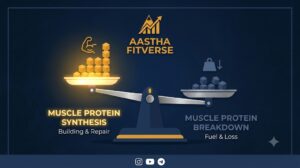
Muscle protein synthesis, often shortened to MPS, is the process by which your body uses amino acids to build new muscle proteins and repair damaged muscle fibers. Every time you lift weights, you create microscopic tears in your muscle tissue. Your body responds by ramping up protein synthesis to repair that damage and, over time, build the tissue back slightly stronger and larger than before.
But here is the part most people miss. Protein synthesis and protein breakdown are happening in your body constantly, every single day, whether you train or not. Muscle growth only happens when synthesis outpaces breakdown over time. Your job as someone chasing strength or a leaner physique is to tip that balance in your favor as often as possible.
 If you are considering adding a protein powder to support your training but feel overwhelmed by the options, this complete beginner’s guide to choosing the right protein powder in a cluttered market will help you make a confident, informed choice.
The Leucine Threshold: The Science That Changes How You Should Eat
This is where most fitness content gets it wrong. People assume that spreading protein evenly across the day or just hitting a daily gram target is enough. Newer research tells a more precise story.
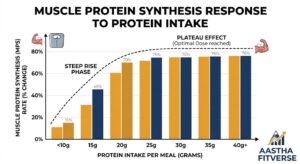
Muscle protein synthesis does not rise gradually with more protein. It behaves more like a switch. There is a minimum concentration of the amino acid leucine that needs to hit your bloodstream before your muscle cells fully activate the mTORC1 pathway, the primary signaling system responsible for triggering protein synthesis. Below that concentration, the response is weak. Once you cross it, synthesis ramps up sharply. Researchers call this the leucine threshold, and it works through leucine activating the mTORC1 signaling pathway via Sestrin2 and GATOR2, producing a step like dose response where there is relatively little muscle protein synthesis until the threshold is crossed, and a near maximal response once it is.
So what does that threshold actually look like in grams of leucine, and grams of protein.
Studies suggest the leucine threshold typically falls between 2.5 and 3 grams of leucine per meal for most adults. In practical food terms, this corresponds to roughly 20 to 25 grams of whey protein, or about 2.5 grams of leucine. If you are older, your muscles become more resistant to this signal, a phenomenon researchers call anabolic resistance. Older adults typically need closer to 3 grams of leucine to cross the same threshold, which is one reason protein needs quietly increase with age even if activity levels stay the same.
Here is the finding that should change how you plan your plates. Once you cross the threshold, eating dramatically more protein in that single meal does not create a bigger anabolic response. Research has found linear increases in the muscle protein synthesis response with meals ranging from 5 grams up to 20 grams of protein, but no significant increase in the response when going from 20 grams up to 40 grams. In other words, a 60 gram protein shake is not twice as effective as a 30 gram one. Your body simply cannot use the excess for building muscle in that sitting.
This is why the old bodybuilding habit of eating one giant protein heavy meal a day and calling it done is inefficient. You want to cross that threshold multiple times across the day, not once in a massive spike.
How Often You Should Be Hitting That Threshold
If crossing the leucine threshold is what flips the switch, then the practical strategy becomes obvious. You want to flip that switch as many times a day as realistically possible.
For most people training seriously, that means structuring meals so that you get a meaningful protein dose, around 25 to 40 grams depending on your body size and age, roughly every 3 to 4 hours. This is not about eating six tiny meals out of obsession. It is about making sure you are not going long stretches, especially during the day, without giving your muscles the raw material and the signal they need to keep rebuilding.
This becomes even more important if you are in a calorie deficit while trying to lose fat. During a deficit, both the drive to build muscle and the resistance to breaking it down shift against you. Crossing the leucine threshold consistently becomes one of your main defenses against losing hard earned muscle while cutting. If fat loss is currently your primary goal, our detailed guide on fat loss tips for women over 30 pairs well with this protein strategy, since preserving muscle is what keeps your metabolism from slowing down during a cut.
The 48 Hour Window Nobody Talks About
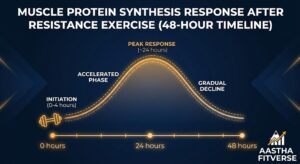
Here is something that will change how you think about your weekly split. When you train a muscle group with resistance exercise, protein synthesis does not just spike for an hour and disappear. The fractional synthetic rate of muscle protein is stimulated for as long as 48 hours following exercise.
But there is important nuance here depending on your training experience. In a landmark tracer study on this exact question, researchers found that muscle protein synthesis increases rapidly after a bout of heavy resistance training, is more than double at 24 hours, and thereafter declines rapidly so that by 36 hours it has almost returned to baseline. If you are more experienced and well trained, that window can actually be shorter. Mechanistic data shows that MPS is meaningfully reduced 48 hours after a resistance training bout in untrained individuals, and may even return closer to baseline sooner in trained individuals.
What this means practically is that once you have been training consistently for a few months, your body recovers and resets its protein synthesis response faster. This is exactly why intermediate and advanced lifters often benefit from training a muscle group twice a week instead of once, while total beginners can sometimes get away with less frequency because their synthesis window and the associated muscle damage repair process runs longer per session.
What Actually Triggers Protein Synthesis: The Three Pillars
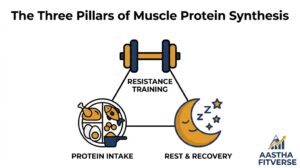
Based on the research, there are three non negotiable inputs that drive protein synthesis. Miss any one of them consistently and you are capping your results no matter how hard you train.
1. Mechanical Tension Through Resistance Training
Lifting weights, particularly training close to failure with a full range of motion, is the strongest trigger for muscle protein synthesis. Bodyweight training and cardio have their place, but they do not create the same magnitude of mechanical tension needed to send a strong enough signal to your muscle fibers. If you are unsure whether your current training style is actually building muscle or just burning calories, our post on common fitness myths that are wasting your time covers a few training misconceptions worth revisiting.
2. Adequate Leucine Rich Protein at the Right Frequency
As covered above, this means real protein sources at each meal, not an afterthought. Whey protein, eggs, chicken, fish, paneer, Greek yogurt, and lentils combined with grains are all strong sources. If you are someone who trains fasted or skips breakfast, know that you are likely missing an easy opportunity to cross the threshold early in the day.
3. Sufficient Total Calories and Recovery
Protein synthesis is an energy expensive process. Your body is far less willing to build new tissue when it is in a severe calorie deficit or sleep deprived. This is one of the most underrated points in the whole conversation. You can eat perfect protein and train perfectly, but if you are sleeping five hours a night or crash dieting, your synthesis rates will suffer regardless.
A Common Misconception: More Protein Is Always Better
There has been a wave of newer research pushing back on the idea that more protein per meal is automatically superior. One recent 2026 analysis pointed out that moderate leucine doses of around 2 to 3 grams per meal are sufficient to maximally stimulate muscle protein synthesis, and that beyond this point additional intake offers diminishing returns from a muscle building perspective.
This does not mean high protein diets are bad for you. It means the extra protein beyond your threshold is being used elsewhere in the body, for other tissues, hormones, and general repair, rather than driving additional muscle growth in that specific meal. If your overall goal is muscle gain, your money is better spent on distributing protein intelligently across the day rather than stacking it all into one enormous meal.
If your protein intake has been inconsistent or you have been relying too heavily on shakes without real food, pair this guide with our piece on muscle recovery foods for a full list of whole food sources that support this process naturally.
Also If you want to make sure you are not wasting effort on things that do not even work, take a look at these fitness myths you should stop believing, so your discipline is aimed in the right direction from day one.
The Workout Routine Built Around Protein Synthesis Science
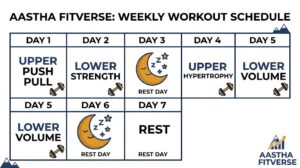
Given everything above, here is a training split designed specifically to work with your body’s protein synthesis window rather than against it. This routine trains each muscle group twice within a 7 to 8 day cycle, which aligns well with the 36 to 48 hour recovery window discussed earlier for reasonably trained lifters.
Upper Lower Split, 4 Days a Week
Day 1: Upper Body Push and Pull
Bench press, 4 sets of 6 to 10 reps Barbell or dumbbell rows, 4 sets of 8 to 10 reps Overhead shoulder press, 3 sets of 8 to 12 reps Lat pulldown, 3 sets of 10 to 12 reps Face pulls, 3 sets of 12 to 15 reps Bicep curls and tricep pushdowns, 3 sets each of 10 to 15 reps
Day 2: Lower Body Strength Focus
Barbell back squat, 4 sets of 6 to 8 reps Romanian deadlift, 4 sets of 8 to 10 reps Walking lunges, 3 sets of 12 reps per leg Leg press, 3 sets of 10 to 12 reps Standing calf raises, 4 sets of 12 to 15 reps Core work, planks and hanging leg raises, 3 sets each
Day 3: Rest or Active Recovery
Light walking, mobility work, or gentle yoga. This is not a wasted day. This is when a large portion of your protein synthesis from Day 1 and Day 2 is actively happening.
Day 4: Upper Body Hypertrophy Focus
Incline dumbbell press, 4 sets of 10 to 12 reps Seated cable row, 4 sets of 10 to 12 reps Lateral raises, 4 sets of 12 to 15 reps Chest supported rear delt fly, 3 sets of 12 to 15 reps Close grip bench press, 3 sets of 8 to 10 reps Hammer curls, 3 sets of 10 to 12 reps
Day 5: Lower Body Volume Focus
Front squat or goblet squat, 4 sets of 8 to 10 reps Hip thrusts, 4 sets of 10 to 12 reps Bulgarian split squats, 3 sets of 10 reps per leg Leg curls, 3 sets of 12 to 15 reps Seated calf raises, 4 sets of 15 reps Core work, cable crunches or weighted sit ups, 3 sets
Day 6 and 7: Rest
Full recovery days. Prioritize sleep and protein intake here just as much as on training days, since this is when the majority of the actual rebuilding happens.
Notice the structure. Each muscle group gets trained, then gets roughly 72 hours before being trained again directly, while getting indirect stimulus in between. This respects the research showing meaningful protein synthesis elevation for up to 48 hours, while not leaving so much time between sessions that you lose training frequency benefits.
Sample Meal Timing to Match This Routine

To actually cross the leucine threshold consistently, here is what a training day could look like.
Early morning, 25 to 30 grams of protein from eggs or a Greek yogurt bowl before or shortly after training Post workout meal, 30 to 40 grams of protein from chicken, paneer, or a whey shake combined with carbohydrates Afternoon meal, 25 to 30 grams of protein from lentils, fish, or tofu Evening meal, 25 to 35 grams of protein from a lean meat or dairy based source, with slow digesting casein protein before bed if you train late
This spreads four clear protein synthesis triggers across your day instead of one or two, matching what the research actually supports rather than outdated bro science advice about needing protein within a narrow 30 minute anabolic window.
Bringing It All Together
Protein synthesis is not complicated once you understand the mechanism. Your muscles need a strong enough mechanical signal from resistance training, a threshold dose of leucine rich protein delivered consistently across the day, and enough total energy and rest to actually carry out the rebuilding process. Chase all three consistently and your body will respond, slowly but reliably, the way it is designed to.
If you are someone juggling recovery on top of other physical demands, especially postpartum, our dedicated guide on postpartum fat loss walks through how to apply these same protein synthesis principles while your body is also healing from childbirth.
Strength. Discipline. Results. That is not just our tagline, it is quite literally the biology of how muscle gets built, one properly timed meal and one well structured training session at a time.
For more simple fitness tips, beginner-friendly workout plans, and easy habits that actually fit into a busy life, explore more blogs on AasthaFitVerse like Home Workout Plans, Fat Loss Diet Guides, and Daily Fitness Habits—everything is designed to help you stay consistent without stress