Fitness Myths You Should Stop Believing:
Walk into any gym and you will hear at least five wrong things before you even finish your warm up. Someone will tell you that lifting weights makes women bulky. Someone else will swear that crunches burn belly fat. And there is always that one person who insists you must eat every two hours or your metabolism will “shut down.”
None of this is true. And yet these myths spread faster than actual science because they sound logical, they get repeated by influencers with big arms, and honestly, they are easier to believe than the boring truth that fitness mostly comes down to consistency, patience, and a few basic principles done correctly over a long time.
Let us break down the biggest fitness myths that are quietly wasting your time, your motivation, and sometimes your money.
Myth 1: Spot reduction works, you can target fat loss in one area
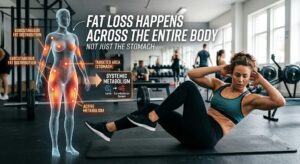
This is probably the most persistent myth in fitness history. The belief is simple. Do enough crunches and your belly fat disappears. Do enough tricep dips and your arm fat melts away. It feels intuitive, which is exactly why it refuses to die.
Here is the problem. Your body does not pull fat from the muscle directly underneath that is working. Fat loss happens systemically, based on your overall calorie balance, hormones, and genetics, not based on which muscle you just exhausted. When you do hundreds of crunches, you are training your abdominal muscles. You are not telling your body, “please burn fat specifically from this region first.”
A landmark study published in the Journal of Strength and Conditioning Research had participants train only one leg for weeks. Fat loss occurred across the entire body, not just the trained leg. That single piece of research quietly destroyed the spot reduction myth, yet gyms are still full of people doing endless side bends hoping to carve out their obliques.
The real path to losing fat in a specific area is losing overall body fat through a sustainable calorie deficit, combined with strength training to build the muscle underneath so that when the fat does come off, there is shape to reveal.
Where you lose fat first or last is largely determined by genetics and hormonal patterns, which is why two people on the exact same program can see completely different results in completely different order. Some people lose face and arm fat quickly while their midsection takes longer. Others see the opposite. Fighting your own biology by obsessing over one body part with isolated exercises wastes time that would be better spent on a structured full body program and a sensible eating plan.
 Not sure how to track your numbers? Read How to Track Calories Without an App? (Simple Beginner Method That Actually Works).
Myth 2: Lifting weights makes women bulky

This myth has probably kept more women away from strength training than any other piece of fitness misinformation. The fear is that picking up a dumbbell will somehow turn you into a bodybuilder overnight.
The biology simply does not support this. Building large amounts of muscle requires a specific combination of high testosterone levels, years of progressive heavy training, a calorie surplus, and often a genetic predisposition. Women naturally have significantly lower testosterone than men, which makes the kind of extreme muscle growth people fear biologically difficult, not impossible with extreme dedication, but certainly not something that happens from a few sessions a week.
What actually happens when women lift weights consistently is far less dramatic and far more useful. You build lean muscle, which improves your resting metabolism. You improve bone density, which matters enormously as you age. You get stronger joints, better posture, and a body composition that looks toned rather than bulky. Strength training is one of the most effective tools for fat loss and long term health, and avoiding it because of an outdated myth means missing out on real results.
Myth 3: You need to eat every two to three hours to keep your metabolism running

This idea created an entire industry of six small meals a day plans. The logic sounded convincing. Eating frequently supposedly keeps your metabolic fire burning, while long gaps between meals supposedly send your body into starvation mode and slow everything down.
Research on meal frequency tells a very different story. Multiple studies comparing different eating frequencies, including research published in the British Journal of Nutrition, found no significant difference in metabolic rate between people eating three meals a day versus six smaller meals, as long as total calorie and protein intake remained the same. Your metabolism is influenced by your total food intake, your muscle mass, your activity levels, and genetics, not by how many times you chew during the day.
This is actually good news because it means you do not need to carry containers of food everywhere and panic if you miss a snack. Intermittent fasting protocols, where people eat within a shorter window each day, have shown similar or even better results for many individuals precisely because eating frequency itself is not the deciding factor. What matters is whether your total intake matches your goals.
For a full daily meal plan, see High Protein Diet Plan for Muscle Gain: Simple Daily Meal Guide for Veg, Non-Veg & Vegan.
Myth 4: Cardio is the only way to lose weight, and lifting will not help

There is a common belief that if your goal is fat loss, the treadmill is your best friend and weights are optional extras. This pushes a lot of people toward hours of repetitive cardio while neglecting strength training entirely.
The truth is that strength training plays a massive role in fat loss, often a bigger one than people realize. Muscle tissue is metabolically active, meaning it burns calories even while you are resting. The more lean muscle you carry, the higher your baseline calorie burn throughout the day. Cardio burns calories during the session itself, but strength training builds a body that burns more calories around the clock.
There is also the afterburn effect, technically called excess post exercise oxygen consumption, where intense strength training keeps your metabolism elevated for hours after you finish working out. Research published in the Journal of Translational Medicine has shown that resistance training combined with proper nutrition leads to meaningful improvements in body composition, often outperforming cardio only approaches for long term fat loss.
This does not mean cardio is useless. It is excellent for heart health, endurance, and burning extra calories. But treating it as the only tool while ignoring strength training means leaving significant results on the table.
Myth 5: No pain, no gain, soreness means a workout actually worked

So many people judge whether their workout was effective purely based on how sore they feel the next day. If they cannot walk down the stairs without wincing, they consider it a successful session. If they feel fine, they assume they did not push hard enough.
Muscle soreness, known as delayed onset muscle soreness, happens due to microscopic damage in muscle fibers, often from new or unfamiliar movements, sudden increases in intensity, or longer eccentric contractions. It is not a reliable indicator of how effective your workout was for building strength or burning fat. You can have an incredibly productive, well structured workout and feel barely sore, especially as your body adapts to a consistent routine.
Chasing extreme soreness as a goal can actually backfire. It often comes from poor form, sudden volume spikes, or overtraining, which increases injury risk and can disrupt your recovery and consistency. Progress in fitness is measured through performance over time, such as lifting heavier weights, running faster, recovering quicker, or improving your endurance, not by how difficult it is to sit down the next morning.
Myth 6: You must work out every single day to see results

Discipline culture loves the idea that rest is weakness and that true commitment means training seven days a week without exception. People feel guilty taking a day off, convinced that any pause will erase their progress.
In reality, rest is where a huge part of physical improvement actually happens. When you train, especially with resistance exercise, you create small amounts of stress and damage in your muscles. The actual growth and repair process happens during rest, when your body rebuilds those tissues stronger than before. Skipping rest days does not accelerate this process, it interrupts it.
Overtraining without adequate recovery has been linked to increased injury risk, hormonal imbalances, disrupted sleep, and even decreased performance over time. Most fitness professionals recommend at least one to two rest days per week, depending on training intensity, along with proper sleep, since growth hormone release and muscle repair are heavily tied to sleep quality. Working out every single day without rest is not dedication, it is often a fast track to burnout or injury.
Myth 7: Supplements are necessary for real results

Walk past any supplement store and you will see promises of faster fat loss, instant muscle gain, and superhuman energy, all conveniently available in a tub of powder. This creates the impression that without the right supplement stack, your results will be limited no matter how hard you train.
The truth is far less exciting but far more important. Supplements are designed to support an already solid foundation of training, nutrition, and sleep. They cannot replace any of those fundamentals. Protein powder is simply a convenient way to hit your protein targets, not a magic substance. Creatine has strong research behind it for performance and strength, but it works by supporting training you are already doing consistently, not by doing the work for you.
Most people chasing supplements have not yet maximized their actual training program, calorie intake, or sleep quality, which are responsible for the vast majority of results. Spending money on a long supplement list while skipping consistent training and proper nutrition is like buying premium tires for a car with no engine.
This is not to say every supplement is useless. A handful, such as creatine, caffeine, and protein powder, have decades of solid research behind them. But even the best supplement on the market typically accounts for a small percentage of overall progress compared to training program design, total daily calories, protein intake, and sleep. If your fundamentals are weak, no supplement, however expensive or heavily marketed, will compensate for that gap.
What about creatine? Should I take that too? Creatine is a different supplement. It helps with strength and power, not direct muscle repair. Read Should You Take Creatine? A Complete Guide for Men and Women for the full picture.
Myth 8: If you stop working out, your muscle turns into fat
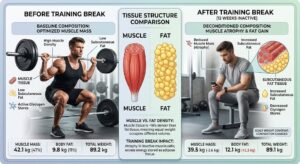
This myth probably came from people noticing that when they stopped training, they appeared to lose muscle definition while gaining some fat, leading to the false conclusion that one tissue transformed into the other.
This is biologically impossible. Muscle and fat are two completely different types of tissue with different cellular structures. One cannot convert into the other, in either direction. What actually happens when someone stops training is that muscle tissue gradually shrinks due to lack of use, a process called atrophy, while if their calorie intake stays the same as when they were active, that excess energy gets stored as fat. Two separate processes happening at the same time create the illusion of transformation, but no actual conversion occurs.
Understanding this matters because it removes unnecessary fear. If you need to take a break from training due to injury, travel, or life circumstances, your muscle will not magically become fat. You may lose some strength and size over time without training, but resuming consistent exercise will rebuild that muscle, often faster than it took to build originally due to a phenomenon researchers call muscle memory.
The real takeaway
Most fitness myths survive because they offer a shortcut, a simple rule that feels satisfying without requiring patience or nuance. Real fitness progress is rarely dramatic or instant. It comes from consistent strength training, adequate protein intake, enough sleep, manageable stress levels, and showing up regularly over months and years rather than chasing whatever trend currently dominates social media.
The next time you hear a fitness claim that sounds too simple or too good to be true, pause before accepting it. Ask where the actual evidence comes from. The fitness industry profits enormously from confusion, repackaging the same basic principles into endless new products and rules. Once you understand what is actually true, you stop wasting energy on things that do not matter and start investing it in things that genuinely move you forward.
For more simple fitness tips, beginner-friendly workout plans, and easy habits that actually fit into a busy life, explore more blogs on AasthaFitVerse like Home Workout Plans, Fat Loss Diet Guides, and Daily Fitness Habits—everything is designed to help you stay consistent without stress