6-Day Push/Pull/Leg Workout & Meal Plan: If you’ve only got two dumbbells at home, you can still build real muscle and strength. You don’t need a bench, a rack, or a barbell. This guide gives you a 6-day Push/Pull/Legs workout plan plus a meal plan to help you grow; all using just a pair of adjustable dumbbells.
Why Dumbbell-Only PPL Powerbuilding Works
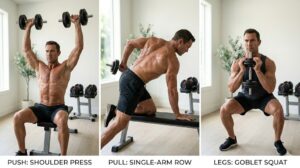
Powerbuilding blends the heavy, lower-rep focus of powerlifting with the higher-volume pump work of bodybuilding. Training each muscle group twice per week — the hallmark of a 6-day Push/Pull/Legs (PPL) split tends to outperform once-weekly training for muscle growth, because the same total weekly volume gets spread across more sessions, letting you train each muscle group hard while it’s still fresh.
The challenge with home training is equipment. Two dumbbells can’t match a barbell for raw loading capacity, but they make up for it with constant tension, unilateral strength balance, and joint-friendly ranges of motion. This program leans into those strengths: controlled tempo, paused reps, deep stretch positions, and intensity techniques like drop sets and rest-pause sets to make a moderate dumbbell load feel as demanding as a heavy barbell.
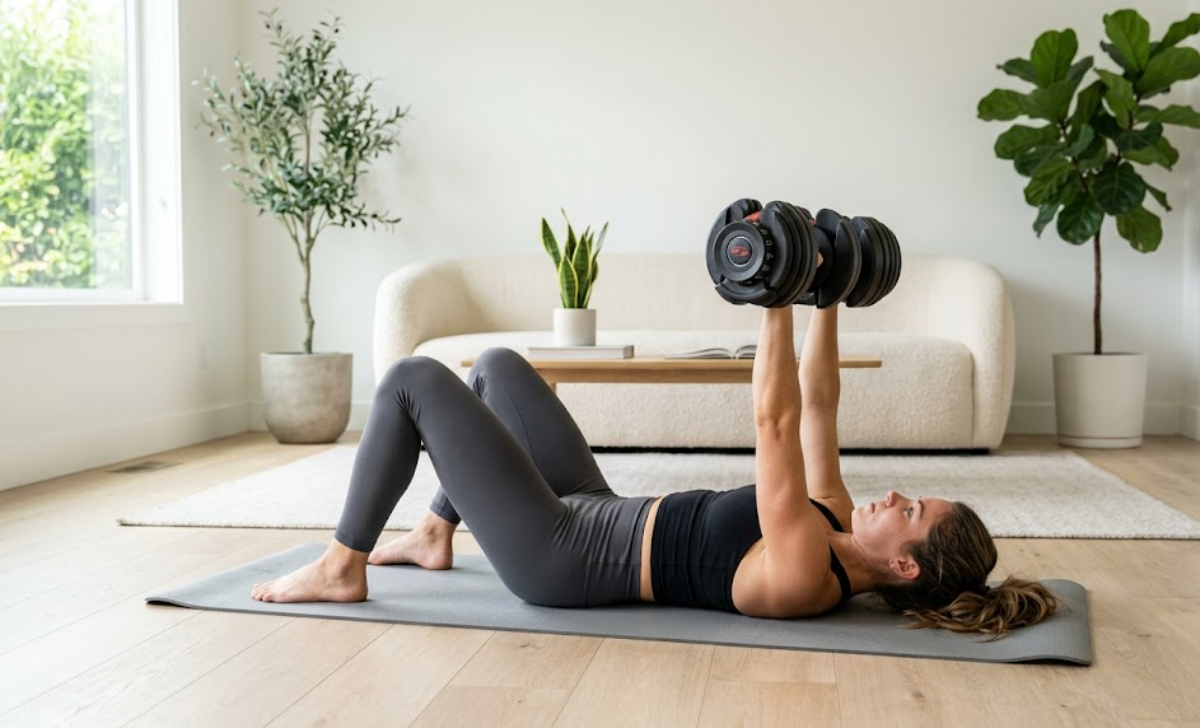
Dumbbells also force each side of your body to work independently. A barbell bench press lets a stronger right arm quietly do more of the work than the left; a dumbbell floor press won’t let you get away with that. Over months of training, this kind of unilateral demand tends to even out left-right strength imbalances that barbell-only lifters often carry for years without noticing.
Training off the floor or household furniture also changes range of motion in a useful way. A barbell bench press stops when the bar touches your chest; a dumbbell floor press stops when your upper arm touches the ground, usually a deeper, more shoulder-friendly stretch. The same logic applies to goblet squats, Romanian deadlifts, and split squats you’ll often get a better stretch on the working muscle than the equivalent barbell version allows.
New to lifting? Try this 4 Day Dumbbell Only Upper Lower Workout Routine for Beginners to build muscle at home.
Program Overview
- Equipment: 2 adjustable dumbbells only (ideally loadable to at least 50–60 lb each)
- Split: Push / Pull / Legs, run twice across 6 training days, with 1 rest day
- Frequency: every muscle group trained twice per week
- Rep ranges: 5–8 on strength-focused lifts, 10–15 on hypertrophy accessories, 15–20+ on finishers
- Rest periods: 2–3 minutes on heavy compound lifts, 60–90 seconds on accessories
- Suggested weekly layout: Push (Day 1) – Pull (Day 2) – Legs (Day 3) – Rest (Day 4) – Push (Day 5) – Pull (Day 6) – Legs (Day 7), then repeat
How to Make 2 Dumbbells Feel Heavy Enough
The biggest limitation of home dumbbell training isn’t the exercises — it’s running out of weight before your muscles are actually fatigued. These four techniques close that gap without buying more iron.
Slow the tempo: a 3-second lowering phase on every rep roughly doubles the time your muscles spend under tension compared to a normal rep speed, which is often the single biggest lever you have with limited load.
Add a pause: pausing for 1-2 seconds at the bottom of a press or squat removes the elastic “bounce” out of the rep, forcing your muscles to do all the work from a dead stop.
Drop sets: on your last set of an exercise, do as many reps as possible, then immediately drop to a lighter weight (or fewer reps with the same weight, like a one-arm version) and continue without resting.
Rest-pause sets: take a set close to failure, rest 15-20 seconds, then squeeze out a few more reps with the same weight. Repeat once or twice more to turn one moderate set into a much harder one.
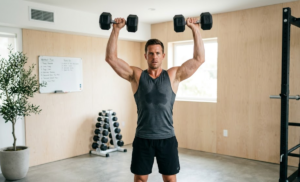
Day 1 & 4: Push (Chest, Shoulders, Triceps)
| Exercise | Sets | Reps | Notes |
|---|---|---|---|
| Dumbbell Floor Press | 4 | 6-8 | Pause 1 second on the floor each rep |
| Dumbbell Incline Press (feet elevated on a chair) | 4 | 8-10 | Improvise an incline using a stack of cushions or stairs |
| Standing Arnold Press | 3 | 8-10 | Rotate palms in through the full range |
| Single-Arm Dumbbell Floor Press | 3 | 10-12 ea. | Slow 3-second lowering phase |
| Dumbbell Lateral Raise | 4 | 12-15 | Light weight, strict form, no swinging |
| Close-Grip Floor Press | 3 | 10-12 | Elbows tucked for triceps emphasis |
| Dumbbell Overhead Triceps Extension | 3 | 12-15 | Drop set on the last set |
Day 2 & 5: Pull (Back, Lats, Biceps, Rear Delts)
| Exercise | Sets | Reps | Notes |
|---|---|---|---|
| Single-Arm Dumbbell Row | 4 | 8-10 ea. | Brace on a sturdy chair or bed frame |
| Dumbbell Romanian Deadlift | 4 | 8-10 | Doubles as posterior chain/back work |
| Renegade Row | 3 | 8-10 ea. | Plank position; resist hip rotation |
| Dumbbell Pullover | 3 | 10-12 | Performed on a bench or stable surface; deep stretch |
| Reverse Fly (bent-over) | 3 | 12-15 | Targets rear delts and upper back |
| Standing Dumbbell Curl | 3 | 8-10 | Strict form, full range |
| Hammer Curl | 3 | 10-12 | Rest-pause on final set |
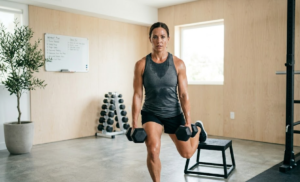
Day 3 & 6: Legs (Quads, Hamstrings, Glutes, Calves)
| Exercise | Sets | Reps | Notes |
|---|---|---|---|
| Dumbbell Goblet Squat | 4 | 8-10 | Hold one dumbbell vertically at chest |
| Dumbbell Romanian Deadlift | 4 | 8-10 | Slightly lighter than the pull-day version if needed |
| Dumbbell Walking Lunge | 3 | 10-12 ea. | Long stride, control the descent |
| Bulgarian Split Squat (rear foot elevated) | 3 | 8-10 ea. | Rear foot on a chair or low step |
| Dumbbell Hip Thrust | 3 | 12-15 | Shoulders on a couch or bed; dumbbell on hips |
| Standing Single-Leg Calf Raise | 4 | 15-20 ea. | Hold dumbbell in one hand for added load |
Day 7: Rest & Recovery
Use this day for light walking, mobility work, or full rest. Recovery between high-frequency sessions is where the muscle growth actually happens, don’t skip it.
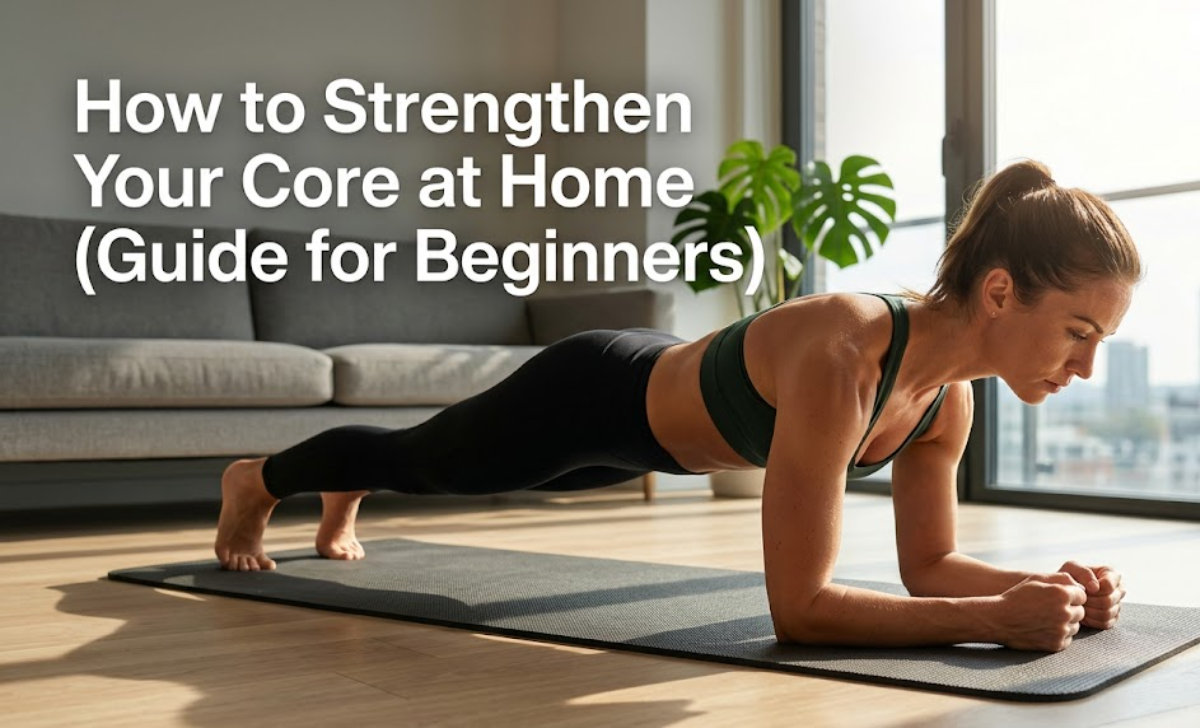
Want a strong core too? Check out this beginner’s guide to core strength — no equipment needed.
Push/Pull/Legs Workout Nutrition & Supplementation
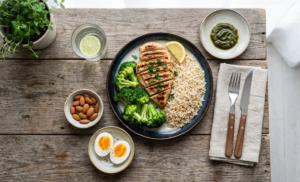
To maximize muscle size and strength gains on this high-frequency, high-volume program, you have to eat big. Start at no less than 3,500 calories per day and adjust based on how you feel and look in the mirror. If you’re not used to eating this much, don’t worry if you gain 3–5 lb during the first two weeks — most of that is water and glycogen from the increased carbohydrate and overall calorie intake. After the first two weeks, aim for a more sustainable 0.5–1 lb of bodyweight gained per week.
The meal and supplementation plan below targets at least 1 gram of protein per pound of bodyweight (for a 180 lb male), 0.5 grams of fat per pound of bodyweight, 30 grams of dietary fiber, 1,000 milligrams of calcium, 350 milligrams of magnesium, 15 milligrams of zinc, and 18 milligrams of iron.
Sample 3,500-Calorie Muscle-Building Meal Plan
| Meal | Foods | Approx. Macros |
|---|---|---|
| Meal 1 – Breakfast | Non-veg/ Eggitarians: 3 whole eggs + 4 egg whites scrambled
Vegeterain/ Vegan: 1 cup oats with 1 tbsp peanut butter, 1 banana |
~620 cal | 38g P | 75g C | 18g F |
| Meal 2 – Mid-Morning | 1 scoop whey protein, 1 cup Greek yogurt, 1 cup mixed berries, 1 oz almonds
|
~480 cal | 45g P | 38g C | 16g F |
| Meal 3 – Lunch | Non-veg/ Eggitarians: 8 oz grilled chicken breast, 1.5 cups cooked rice, 1 cup steamed broccoli, 1 tbsp olive oil
Vegeterain/ Vegan: 1 cup rice, 2 Chapatis, 1 cup veggie, Collage Cheese/ Tofu |
~720 cal | 55g P | 80g C | 14g F |
| Meal 4 – Pre-Workout | 1 cup cottage cheese, 1 rice cake with honey, 1 cup spinach salad
Or Oats banana smoothie: Watch Recipe Here Or Green Gram Chilla: Watch Recipe Here |
~330 cal | 28g P | 40g C | 5g F |
| Meal 5 – Post-Workout | 1 scoop whey protein, 1 cup white rice or 2 rice cakes, 1 cup orange juice | ~440 cal | 35g P | 70g C | 3g F |
| Meal 6 – Dinner | 8 oz lean ground beef or salmon, 1 medium sweet potato, 1 cup mixed vegetables, 1 tbsp butter/ 2-3 Chapatis, 1 cup veggie, Tofu/ Cottage cheese | ~680 cal | 50g P | 55g C | 26g F |
| Meal 7 – Before Bed | 1 cup low-fat cottage cheese, 1 tbsp almond butter, 1 cup milk | ~240 cal | 30g P | 9g C | 12g F |
Daily Nutrition Totals
- 3,510 calories
- 235g protein
- 367g carbohydrates
- 132g fat
- 59g dietary fiber
- 1,550mg calcium — 176% daily value
Need help with food? Here’s a high protein diet plan for muscle gain — with veg, non-veg, and vegan options.
Core Supplements
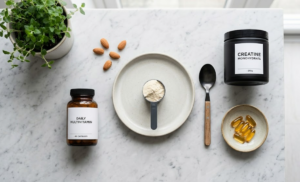
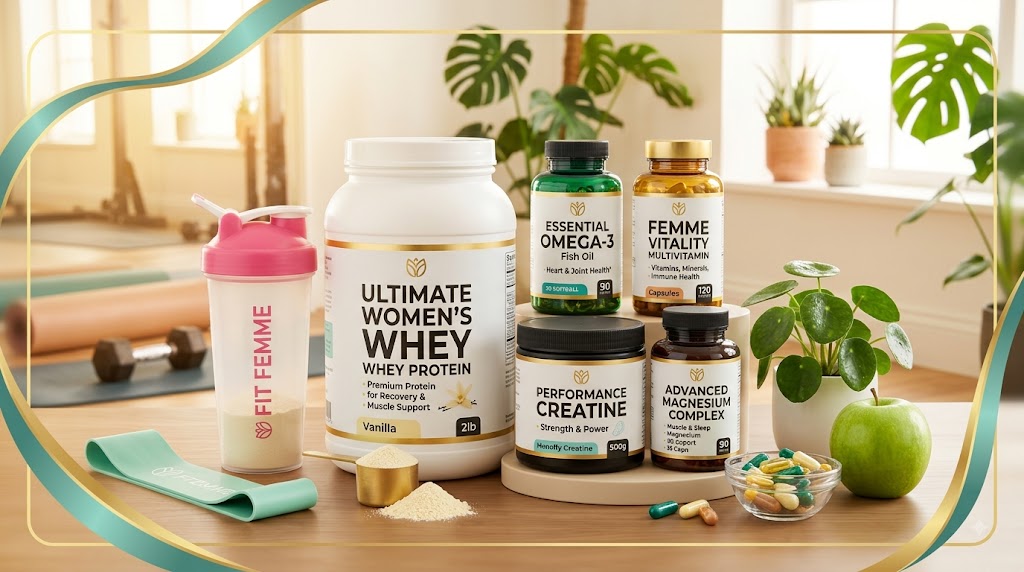
Whey protein powder: the simplest way to hit your daily protein target, especially around training and before bed.
Creatine monohydrate (5g daily): the most well-supported supplement for strength and muscle gain; take it any time of day, consistency matters more than timing.
Fish oil (2-3g daily): supports joint health and recovery, especially valuable given the high training frequency of this program.
Multivitamin: covers gaps in micronutrients like zinc, iron, and magnesium that can be easy to miss while eating in a calorie surplus.
Vitamin D3 (2,000-4,000 IU daily): particularly useful if you train indoors and get limited sun exposure.
Recovery & Sleep
Training a muscle group twice per week with this much volume only works if recovery keeps pace with the workload. Without it, you’ll stall out, feel run-down, and risk overuse injuries from the dumbbell pressing and pulling patterns repeated across the week.
Sleep
- Aim for 7-9 hours of sleep per night; growth hormone release and the bulk of muscle protein synthesis happen during deep sleep.
- Keep a consistent sleep and wake schedule, even on rest days, to stabilize your circadian rhythm.
- Avoid screens and bright light for 30-60 minutes before bed, and keep the bedroom cool and dark.
- Cut caffeine at least 8 hours before bedtime so it doesn’t interfere with sleep onset or depth.
Active Recovery & Lifestyle
- Walk 20-30 minutes on rest days to support blood flow and digestion without adding training stress.
- Stretch or foam roll the muscles trained most recently, focusing on shoulders, hips, and lower back given the volume of pressing and hinging movements.
- Stay hydrated: aim for at least half your bodyweight in ounces of water daily, more on training days.
- Manage stress outside the gym; chronically elevated cortisol blunts recovery and can stall strength gains even when training and diet are on point.
Deload Weeks
Every 6-8 weeks, take a deload week: keep the same exercises but drop volume by roughly 40% (fewer sets, same reps) and intensity by about 10-20% lighter loads. This lets accumulated fatigue dissipate so you come back stronger for the next training block.
No gym access? This easy beginner home workout for weight loss and strength has you covered.
Frequently Asked Questions
Can I really build muscle with only 2 dumbbells? Yes. Muscle growth is driven primarily by progressive tension on a muscle over time, not by the specific tool that creates that tension. Adjustable dumbbells, slower tempos, and intensity techniques like drop sets and rest-pause work let you create enough tension to drive growth even with a limited weight ceiling.
What if my dumbbells don’t go heavy enough? Lean harder on tempo, pauses, and drop sets, and consider adding more reps per set (15-25) once a weight starts to feel easy for 12-15 reps. Single-arm and single-leg variations also let you handle a relatively heavier load per limb than a two-limb version of the same lift.
Is 6 days a week too much? Not if recovery is dialed in. Each muscle group still only gets two hard sessions per week with roughly 48-72 hours between them — it’s the same recovery window as a more traditional 3-4 day split, just spread across more, shorter sessions.
Do I need to eat 3,500 calories even if I’m not 180 lb? No — scale the numbers to your bodyweight. Use roughly 1 gram of protein and 0.5 grams of fat per pound of bodyweight as your starting point, then build carbohydrates around whatever calorie total gets you gaining 0.5-1 lb per week.
Disclaimer: this guide is for general informational purposes and isn’t personalized medical, nutrition, or training advice. Check with a doctor before starting a new training or supplementation program, especially if you have any existing health conditions.
Have questions about starting your home workout journey? Drop them in the comments — I actually read them all and reply.
 For more simple fitness tips, beginner-friendly workout plans, and easy habits that actually fit into a busy life, explore more blogs on AasthaFitVerse like Home Workout Plans, Fat Loss Diet Guides, and Daily Fitness Habits—everything is designed to help you stay consistent without stress